
What Is Content Strategy? A One-Page Plan for Small Businesses (2026)
Content strategy is the written plan behind your posts. Here is the one-page, seven-step version, where AI helps fill it in, and how to measure whether it works.
A content strategy is a written plan that answers six questions: who your content is for, what it should achieve for your business, which topics you will cover, in what formats, where and how often you will publish, and how you will know it is working. Most small businesses do not need a 40-page document. They need one page that a busy owner, freelancer or marketing hire can read in two minutes and follow for a quarter. This guide shows what goes on that page, where AI tools help you fill it in, and where they should stay out of the way.
A note on method: this article is built from the guidance published by Content Marketing Institute (CMI) and Google, linked in the sources below and checked on November 2, 2026. The bookkeeping firm in the example is invented to show the format; it is not a real client and the numbers are placeholders.
The Short Answer
- Content strategy is the "why, for whom and how" behind your content. A content calendar is only the "when."
- CMI defines content marketing as creating and distributing valuable, relevant and consistent content to attract and retain a clearly defined audience, and ultimately to drive profitable customer action. It also says that approach needs a documented strategy.
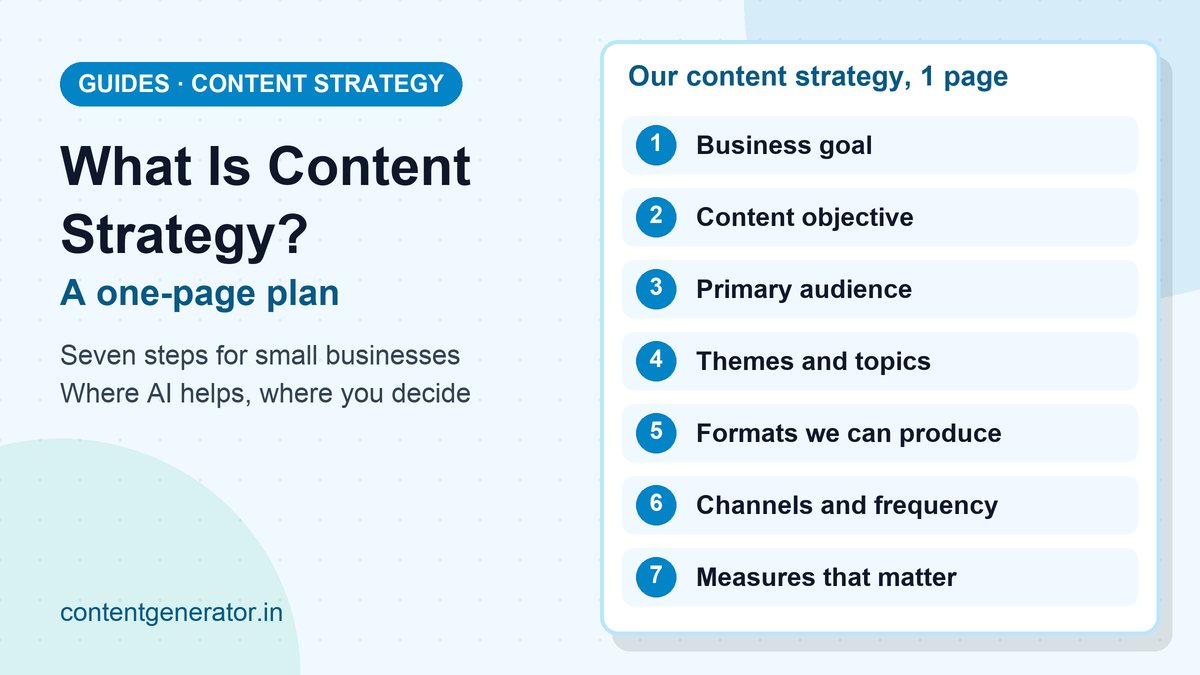
- CMI's own method fits on one page in seven steps: business goal, content objective, audience, topics, formats, channels and frequency, and the link back to the business purpose.
- AI is useful for the research and drafting steps. The decisions (the goal, the audience, the claims you stand behind) stay with a person.
- Pick a publishing frequency you can keep. CMI's advice is not to be overly ambitious, because you can always increase it later.
Strategy, Plan and Calendar Are Not the Same Thing
People use these words interchangeably, which is why many "strategies" turn out to be a spreadsheet of post titles. A quick way to separate them:
- Strategy: the decisions that rarely change within a quarter. The goal, the audience, the themes, the formats and the channels.
- Plan: how you will carry the strategy out: who writes, who approves, what the process and budget are.
- Calendar: the dated list of pieces that comes out of the strategy.
If you start with the calendar, you end up publishing whatever is easy to think of that week. If you start with the strategy, every item on the calendar has a reason to exist, and you can say no to ideas that do not fit.
The One-Page Content Strategy: Seven Steps
CMI's one-page method is a good base because it forces short answers. Here it is in plain terms, with a small bookkeeping firm as the worked example.
1. Start with a business goal
Content has to serve something the business wants. Write one measurable goal. Example: book 20 more free consultations in the next six months.
2. Turn it into a content objective
This is the role content will play, not the topics yet. Example: become the first place freelancers look to understand US self-employment bookkeeping.
3. Choose one primary audience
CMI warns against a broad audience because it is hard to write well for everyone, and suggests one primary audience and possibly a secondary one. Look at their needs, pain points and where they already get information on your topic. Example: US freelancers earning their first $30,000 to $80,000 who do their own books.
4. List content categories and topics
Choose a few broad themes, then sample topics under each. Keep the ones that would help your audience most. Example: three themes (tracking income, quarterly estimates, choosing software) with four starter topics each.
5. Match formats to what you can really produce
Ask how your audience prefers to consume content and which formats your resources allow. CMI's example is blunt: if no one on the team has video skills and there is no budget, do not choose video. Example: two articles a month and one email.
6. Set channels and frequency
Be specific about where each piece goes and how often. Example: articles on the firm's blog every other week, the email once a month, one LinkedIn post per article.
7. Tie it back to the business
Write one sentence that connects the content to the goal in step 1, and name the call to action each piece points to. Example: every article ends with a link to book a free consultation.
Where AI Helps (and Where It Should Not)
Google's guidance on generative AI says it can be particularly useful for researching a topic and adding structure to original content. The same page warns that using AI tools to generate many pages without adding value for users may violate Google's spam policy on scaled content abuse. Use that as your dividing line.
| Strategy step | Good use of AI | Keep with a person |
|---|---|---|
| Goal and objective | Pressure-test your wording | Choosing the goal |
| Audience | Draft question lists to check against real customer emails and calls | Deciding who you serve |
| Topics | Brainstorm angles, group topics into themes | Picking what you have real expertise or data on |
| Production | Outlines and first drafts from a solid brief and a clear prompt | Facts, numbers, quotes, advice |
| Distribution | Turn one article into several formats (repurposing guide) | Final tone and what gets posted |
Two more points from Google's guidance belong in your process. First, generative models predict likely wording rather than retrieve facts, so Google says it is critical to manually fact-check AI-generated content, including titles, meta descriptions and image alt text, before publishing. Our fact-checking guide shows a practical routine. Second, Google suggests explaining how a piece of content was created where that helps readers, and its helpful-content guidance asks "Who, How and Why": is it clear who wrote it, how it was produced, and was it made primarily to help people rather than to attract search visits? For a self-check against the spam rules, see our Google spam policies and AI content audit.
How to Measure It Without a Dashboard Obsession
Your one-page strategy should name two or three numbers, no more.
- Search visibility. Google's Search Console Performance report shows clicks, impressions, click-through rate and average position, and which queries and pages bring people from Google Search. Its default view covers the past three months.
- The action you care about. In Google Analytics, a key event measures an action that is particularly important to your business, such as a consultation booking or a purchase. Mark that event as a key event, then you can see how many users complete it and which channels lead to it.
- Your own output. Pieces published against the frequency you set in step 6. If you cannot keep the schedule, lower the frequency rather than the quality.
Review monthly, change one thing at a time, and write what you changed on the page so the next review has context.
Copy This Template
Business goal: (measurable, with a date)
Content objective: (the role content plays)
Primary audience: (one group, plus their main problem)
Themes and starter topics: (3 themes, 3 to 5 topics each)
Formats: (only what you can produce)
Channels and frequency: (where, how often)
Measures: (search clicks, one key event, output)
AI rules: (what AI may draft, who fact-checks, who approves)
The last line is our addition to CMI's seven steps. Writing the AI rules down in the same place as the strategy keeps drafts from drifting into the thin, mass-produced content that Google's spam policies target.
Common Mistakes
- Starting with keywords instead of readers. Keywords help you phrase topics. They do not tell you who the content is for.
- Choosing every channel. One channel done consistently beats five done occasionally. Our social media content strategy guide covers picking the one or two that fit.
- Letting the calendar run the business. A full calendar is not a result. Check the goal in step 1 each month.
- Publishing AI drafts unreviewed. Speed is the benefit, but a factual error costs more trust than the time you saved. For how search and AI drafts interact, see AI content and SEO.
FAQ
What is content strategy in simple terms?
It is the written plan for what content you create, who it is for, why it exists, where it is published and how you will judge it. A strategy comes before a calendar of posts.
How long should a content strategy be?
For a small business, one page is enough. CMI recommends a single page so that your team and business leaders will actually read it and work in the same direction.
Can I build a content strategy with AI?
You can use AI to brainstorm topics, group them into themes and draft outlines. The goal, audience and claims should be decided and checked by a person, and AI-generated content should be fact-checked before it is published.
How often should a small business publish?
As often as you can keep up for a full quarter. CMI's advice is to pick a frequency you can realistically meet and increase it later.
How do I know if the strategy is working?
Track search clicks and impressions in Search Console, one key event in Google Analytics that reflects your goal, and whether you hit your publishing schedule.
Sources (checked November 2, 2026): Content Marketing Institute, What Is Content Marketing? and How To Write a 1-Page Content Marketing Strategy in a Few Hours; Google Search Central, Creating helpful, reliable, people-first content, Guidance on using generative AI content and Spam policies; Google Search Console Help, Performance report (Search results); Google Analytics Help, About key events. The example business is fictional. We did not test any tools for this article.
Frequently asked questions
What is content strategy in simple terms?
It is the written plan for what content you create, who it is for, why it exists, where it is published and how you will judge it. A strategy comes before a calendar of posts.
How long should a content strategy be?
For a small business, one page is enough. Content Marketing Institute recommends a single page so that your team and business leaders will actually read it and work in the same direction.
Can I build a content strategy with AI?
You can use AI to brainstorm topics, group them into themes and draft outlines. The goal, audience and claims should be decided and checked by a person, and AI-generated content should be fact-checked before it is published.
How often should a small business publish?
As often as you can keep up for a full quarter. Content Marketing Institute's advice is to pick a frequency you can realistically meet and increase it later.
How do I know if the strategy is working?
Track search clicks and impressions in Search Console, one key event in Google Analytics that reflects your goal, and whether you hit your publishing schedule.