
AI Content Brief Checklist: 12 Things to Settle Before You Prompt
Most weak AI drafts start with a weak brief. A 12-point checklist for the reader, intent, angle, sources, claim limits and sign-off, plus a filled-in example brief.
Most disappointing AI drafts are not a model problem. They are a brief problem. Someone types "write a 1,500-word SEO article about content calendars", gets back a smooth, confident page that could sit on any of a thousand websites, and then spends an hour trying to edit personality and proof into it.
The fix happens earlier. A short, specific brief, written before any AI tool is opened, decides who the page is for, what it must prove, what it must never claim, and who signs it off. This checklist covers the twelve decisions that make the biggest difference, followed by a filled-in example you can copy.
The Short Answer
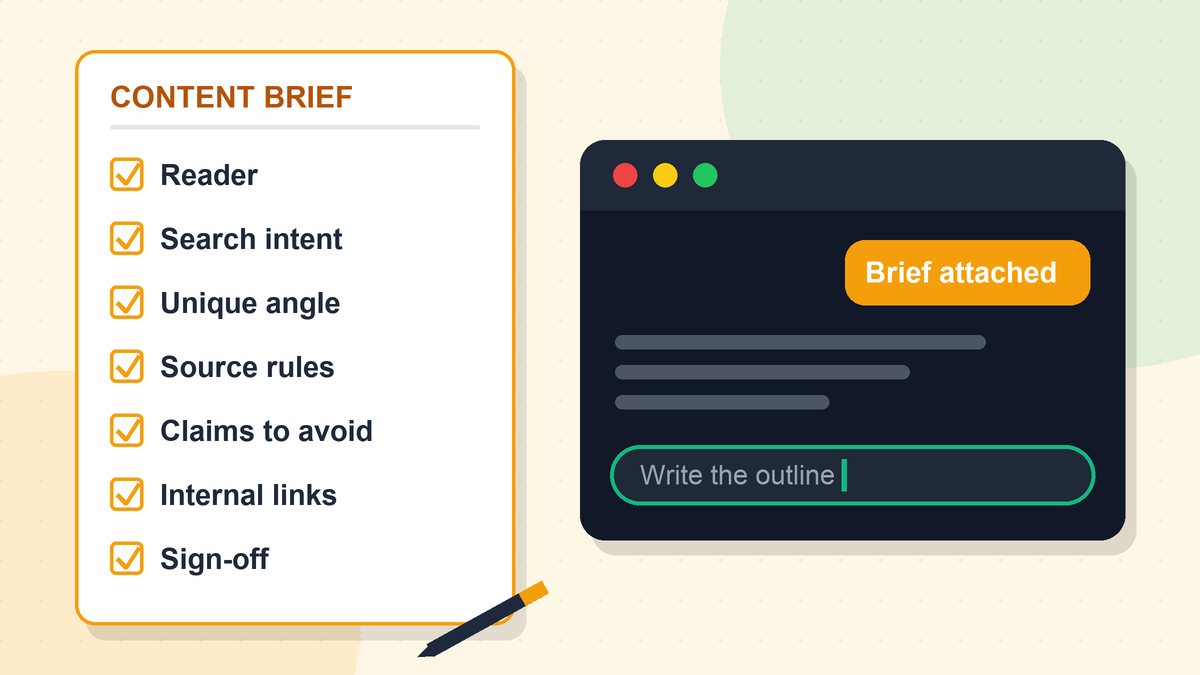
An AI content brief should settle, in writing and before drafting: the specific reader, the search intent, the angle only you can offer, the sources the draft must rely on, the claims it must not make, the outline, the original examples to include, the internal links and call to action, the SEO fields, and the name of the person who reviews and approves the final page. If you cannot fill those fields in, the topic is not ready for AI drafting yet.
Why the Brief Matters More When AI Writes the Draft
A human writer quietly fills gaps in a weak brief with their own judgement. A language model fills the same gaps with the most statistically average answer, which is exactly the generic content readers and search engines skip.
Google's own guidance draws the line in a useful place. Its page on using generative AI content says AI can be helpful for researching a topic and adding structure to original content, but that generating many pages without adding value for users may violate its spam policy on scaled content abuse. Its helpful content guidance asks whether a page provides original information, analysis or insight, and suggests thinking about the "Who, How and Why" behind it. A good brief is where you answer those questions on purpose instead of hoping the draft answers them by accident.
The 12-Point AI Content Brief Checklist
1. One specific reader
Describe one person: what they already know, what they are trying to decide, and what they should be able to do after reading. "A freelance writer who has been asked by a client to use AI and wants to keep the quality up" produces a very different draft from "people interested in content marketing".
2. The search intent, in one line
State what the reader came to do: learn a concept, follow a checklist, compare two options, fix a problem, or decide whether to buy. If the intent is a checklist, do not ask for a broad explainer. If it is a comparison, say which options and on which criteria. Most off-target drafts come from an intent that was never written down.
3. The angle only you can offer
Answer the question "why should this page exist when ten similar ones already rank?" Useful answers include a workflow you actually run, the questions your clients ask most, a before-and-after from your own work, a local market view, or a mistake you made and fixed. "A complete guide to X" is not an angle; it is a request for the average of everything already published.
4. Source rules
List the sources the draft must use (official documentation, primary data, your own records), the claims that need a citation, and the facts that change often and must be checked on the day you publish, such as prices, plan limits and policy wording. Models write confidently about details they cannot know, so the brief should say plainly: no statistic without a named source. Topics touching health, money, law or security need primary sources and a qualified reviewer, not just a careful prompt.
5. Claims the page must not make
Write the boundaries down. Typical ones: no guaranteed rankings or results, no "tested" or "we tried" language unless someone really tested it, no invented customer numbers, no implied endorsement by a platform, and no promise that a process can run without human review. This one field prevents more embarrassing corrections than any other.
6. The outline you want, not the outline the model guesses
Give the H1, a short answer near the top, the main sections in order, where a table or checklist belongs, and whether an FAQ is genuinely useful. You know the reader's journey; the model does not. Letting it pick the structure is how you end up with an introduction that restates the title three times.
7. Original examples to include
Ask for the material only you have: a real question from a client, a screenshot you will describe, numbers from your own project, a template you use. AI can make that material read smoothly, but it cannot invent your experience. If the brief contains no first-hand material, the draft will not either.
8. Internal links and the call to action
Choose two to four existing pages the article should point to and the one next step you want the reader to take. The call to action should match where the reader is: a beginner reading a checklist wants the next guide, not a sales pitch in paragraph two.
9. SEO fields
Draft the working title, a meta description and the main query before the article exists, so the draft is written to match them rather than retrofitted. Our guides on writing title tags and writing meta descriptions cover both fields in detail.
10. Format for people first
Google's guide to generative AI search says the foundations still apply: create valuable, non-commodity content and keep a clear technical structure. In a brief, that means asking for clear headings, a direct answer early, short paragraphs and specific details rather than writing for AI summaries. Our post on writing for AI Overviews goes deeper on this.
11. A named reviewer and a fact-check step
Put a name next to "reviewed by" and list what they must check: every number, every quoted rule, every product feature, every link. A practical process is in how to fact-check AI-generated content. Also note how AI was used, so anyone updating the page later knows which parts came from the model and which from people.
12. A publish-or-park decision
End the brief with the bar the draft must clear to go live, and what happens if it does not: rewrite once, merge into an existing page, or park it. Without this field, every draft eventually gets published because it already exists.
Score the Brief Before You Prompt
Give one point for each of the twelve items that is filled in with something specific (a placeholder like "general audience" scores zero). Ten or more: draft. Eight or nine: fix the gaps first, it takes ten minutes. Below eight: the topic needs more thinking, or more first-hand material, before any tool touches it. Improving a brief is almost always faster than rescuing a weak draft.
A Filled-In Example Brief
Here is what a complete brief looks like for a small, realistic piece:
- Reader: a bakery owner in Pune updating a three-year-old "custom cakes" service page that gets visits but few enquiries.
- Intent: decide what to change on the page before republishing it.
- Angle: an editor's before-and-after of this exact page, not general SEO tips.
- Sources: the bakery's current price list, order lead times and delivery area (owner to confirm on the day), plus Google's helpful content guidance.
- Must not claim: "best in Pune", ranking promises, review counts we have not verified, eggless options the kitchen does not offer.
- Outline: what the page is missing, the rewritten opening, a lead-time table, ordering steps, three real customer questions as an FAQ.
- Original material: five photos of past orders (to be described), the three most common WhatsApp questions from customers.
- Links and CTA: link to the menu page and the delivery-area page; CTA is "check a date and enquire".
- Reviewer: the owner checks prices, timings and photos; the editor checks tone and links.
- Publish bar: every price and lead time confirmed; otherwise hold the update.
With this, an AI tool can produce a useful first outline in a minute, and the human time goes into the parts that matter: real photos, confirmed prices and the owner's voice.
Where the Brief Fits in the Workflow
The brief is step one of a longer loop: brief, outline, section-by-section draft, edit, fact-check, approve, publish, then refresh when facts change. Our AI content editing workflow covers the editing stage, and the AI content refresh checklist covers updating older pages. If you are new to drafting with AI, start with how to generate blog posts with AI without sounding robotic.
FAQ
How long should an AI content brief be?
Usually one page. Long enough to fill the twelve fields with specifics, short enough that someone will actually read it before drafting. If it runs to several pages, part of it is probably the article itself.
Can AI write the content brief too?
It can help: suggesting outline sections, common reader questions or missing subtopics. But the reader, the angle, the source rules, the claim limits and the reviewer are business decisions, and those should come from a person who knows the business.
Does Google penalise AI-assisted content?
Google's published position is that it rewards helpful, reliable content however it is produced, and that mass-producing pages without adding value can break its spam policies. We cover this in more detail in AI content and SEO.
Sources
- Google Search Central: Google Search's guidance on using generative AI content on your website
- Google Search Central: Creating helpful, reliable, people-first content
- Google Search Central Blog: Google Search's guidance about AI-generated content (February 2023)
- Google Search Central: Google's guide to optimizing for generative AI features on Google Search