How to Fact-Check AI-Generated Content Before You Publish
An AI writing assistant can turn an outline into a clean draft in a minute. What it cannot do is promise that the draft is true. The sentences read smoothly whether the facts behind them are right, half-right or invented, and that is exactly why errors slip through: nothing about a hallucinated statistic looks different from a real one.
Google says this plainly. Its guidance on using generative AI content (last updated October 1, 2026) explains that generative models "don't retrieve facts, but predict a likely sequence of words," and that it is "critical to manually factcheck and review all AI-generated content for accuracy and trustworthiness before publishing."
This guide is the practical version of that sentence: a repeatable process for checking an AI-assisted draft before it goes live, whether you publish one post a week or manage a small team of writers.
The Short Answer
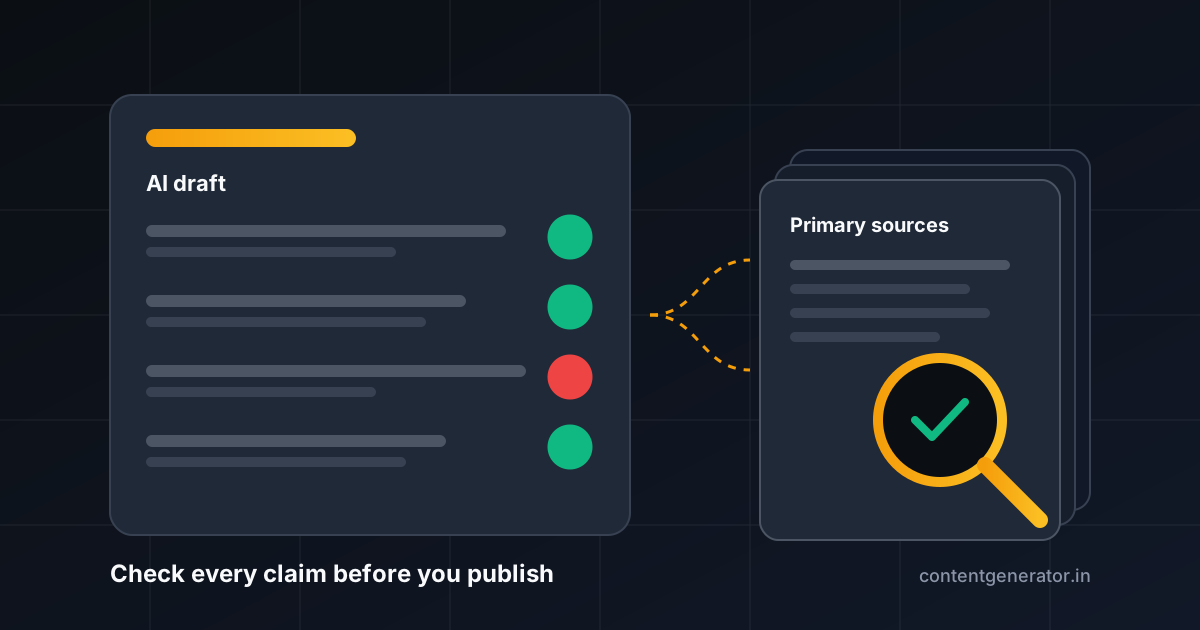
To fact-check AI content, pull every factual claim out of the draft, rank the claims by how much damage a mistake would cause, verify each high-risk claim against a primary source you have actually opened, fix or delete anything you cannot confirm, then check the parts readers see in search results: the title, meta description, image alt text and any structured data. Keep a short log of what you checked so the next editor does not have to start from zero.
What AI Drafts Usually Get Wrong
Most AI errors are not wild. They are plausible, which makes them harder to catch. The patterns worth watching for:
- Invented or mismatched sources. A citation that looks real but points to a page that does not exist, or a real page that says something different.
- Stale facts. Prices, plan limits, feature lists and policy wording that were true when the model was trained and have changed since.
- Precise-sounding numbers. Percentages and survey results with no traceable origin.
- Merged entities. Two products, people or studies blended into one, with details from each.
- Quotes that were never said. A paraphrase presented as a direct quotation, or a quote attached to the wrong person.
- Overconfident summaries of rules. Claims like "Google penalizes AI content" or "this is illegal in the EU" stated as settled fact.
If you already run an editing workflow for AI drafts, fact-checking deserves its own pass. Editing for voice and editing for truth use different parts of your attention, and mixing them is how errors survive.
Step 1: Build a Claim Inventory
Before you touch the prose, list every statement in the draft that could be true or false. That includes numbers, dates, names, product features, prices, quotes, legal or policy statements, "studies show" lines and any comparison between tools.
You can ask the AI tool to extract this list for you. That is a reasonable use of it, because pulling claims out of text is a structural job. Just treat the list as a starting point: skim the draft yourself afterwards, because extraction can miss claims buried in transitions or captions.
A simple table works well, with columns for the claim, its risk level, the source you checked, the result, and what you changed.
Step 2: Rank Claims by Risk
Not every sentence needs the same scrutiny. Spend your time where an error would hurt a reader or your credibility.
- High risk: anything about health, money, legal obligations or safety; prices and plan limits; product capabilities; statistics; direct quotes; statements about what a company or regulator requires.
- Medium risk: dates of launches and updates, historical context, how a process works in general.
- Low risk: opinions clearly framed as opinions, and general advice that does not depend on a specific fact.
Every high-risk claim gets verified or removed. No exceptions.
Step 3: Go to the Primary Source
A primary source is the place the fact originates: the company's own pricing or documentation page, the original study, the regulator's published guidance, the official changelog. A blog post that repeats the fact is a secondary source at best, and it may have got the fact from an AI draft too.
Three rules keep this step honest:
- Open the link. If the AI supplied a citation, click it. Confirm the page exists and that it actually says what the draft claims it says.
- Read the surrounding context. A sentence lifted out of a page can mean something different from the page as a whole. Policy pages are especially prone to this.
- Check the date on the page. Documentation changes. Many official help pages, including Google Search Central's, show a "last updated" date; use it.
If you cannot find a primary source within a reasonable time, that is information too. Either the claim is wrong, or it is too obscure to support the weight your article puts on it.
Step 4: Treat Numbers and Quotes as Exact-Match Only
A number is either the one in the source or it is wrong. Rounded, extrapolated or "approximately" versions of a statistic the AI produced from memory do not count. The same applies to quotations: if you cannot find the exact words from the named person in a primary source, turn it into a clearly marked paraphrase with a link, or cut it.
When in doubt, a specific, verified statement beats an impressive vague one. "Google's spam policies list using generative AI to create many pages without adding value as an example of scaled content abuse" is less dramatic than an invented percentage, and far more useful.
Step 5: Check What Appears in Search Results
This is the step most people skip. Google's AI guidance notes that the review also applies to metadata such as title elements, meta descriptions, structured data and image alt text, because those can appear directly in Search results.
So read your title and description as claims. Does the title promise something the article does not deliver? Does the FAQ markup answer questions that the visible page does not answer? Does the alt text describe what the image really shows? An inaccurate snippet misleads people before they even reach your page.
Step 6: Rewrite, Don't Just Delete
When a claim fails, the lazy fix is to delete it. Often the better fix is to replace it with what you actually found. Here is a typical example.
AI draft: "Google penalizes AI-generated content, so you should hide any use of AI."
Checked against Google's own pages, both halves are wrong. The spam policies define scaled content abuse as generating many pages primarily to manipulate rankings, "no matter how it's created." And the generative AI guidance suggests the opposite of hiding: it says sharing how content was created can give readers useful context. A corrected sentence might read:
Revised: "Google's spam policies target low-value pages produced at scale, whether or not AI was involved. Its guidance also suggests telling readers how content was created where that makes sense."
The revised version is more accurate, and it is also more helpful. We go deeper on the ranking side in AI content and SEO.
Step 7: Keep a Verification Log
The claim table from Step 1 becomes your record. For each high-risk claim, note the source URL, the date you checked, and whether the claim was confirmed, corrected or removed. It takes a few extra minutes and pays off in three ways:
- When you update the article later, you know exactly which facts to re-check.
- Another editor can review your work without repeating it.
- If a reader challenges a claim, you can answer quickly.
Authorship and Disclosure
Google's page on creating helpful, people-first content asks creators to think about who made the content, how it was made and why. It also warns against deceptive authorship, such as made-up names, AI-generated headshots or false credentials designed to make content look expert-written.
The practical takeaway: put a real person's name on work that a real person reviewed, and do not dress up an unreviewed draft as expert analysis. If AI played a meaningful role, a short note on how the piece was produced and checked is usually enough.
Why Volume Makes This Harder
The same Google page describes how quality raters assess effort, and gives "using generative AI to produce large amounts of text without manual oversight or curation" as an example of little to no effort. It adds that attribution to other sources does not replace original effort.
That is the real trade-off. Fact-checking takes time, and the time scales with the number of claims, not the number of words. If your publishing schedule leaves no room to verify what you publish, the schedule is the problem. Publishing fewer, checked articles is a better bet than publishing many unchecked ones.
A Pre-Publish Checklist
- Every factual claim is listed and ranked by risk.
- Every high-risk claim is confirmed against a primary source that you opened yourself.
- Every citation link works and supports the sentence it is attached to.
- Prices, features and policy wording were checked against current official pages.
- Numbers and quotes match their sources exactly, or have been removed.
- Title, meta description, alt text and structured data are accurate.
- Unverifiable claims were rewritten or cut, not softened with "reportedly."
- A named person reviewed the final version.
- The verification log is saved with the draft.
Once the facts are solid, a final pass for tone helps the piece read like it came from a person. Our guide on how to humanize AI content covers that edit, and SEO content writing for beginners covers structure and on-page basics.
FAQ
Can I ask the AI to fact-check its own draft?
You can ask it to list claims or suggest where to look, which saves time. You should not accept its confirmation as proof. A model can repeat the same mistake with the same confidence, so the final check has to be against a source you opened yourself.
Do I need to pass an AI detector before publishing?
Google's published guidance focuses on accuracy, quality and value to readers, not on whether a detector flags the text. A detector score tells you nothing about whether a claim is true, so it is no substitute for verification.
How long should fact-checking take?
It depends on the number and type of claims rather than the word count. An opinion piece with few factual claims is quick. A comparison of tools with prices and plan limits takes longer, because each of those details needs a current official source.
What if two sources disagree?
Prefer the primary source, and the most recently updated one. If the disagreement is real and unresolved, say so in the article instead of picking one side silently.
Should I re-check old AI-assisted articles?
Yes, especially pages with prices, features or policy summaries. Use your verification log to see which claims are time-sensitive and re-check those first.