
Google Spam Policies and AI Content: A Self-Audit for Small Sites
Google doesn't penalize AI content for being AI, but it does target pages made in bulk to rank. Here is what its spam policies say and a nine-point checklist to audit your own site.
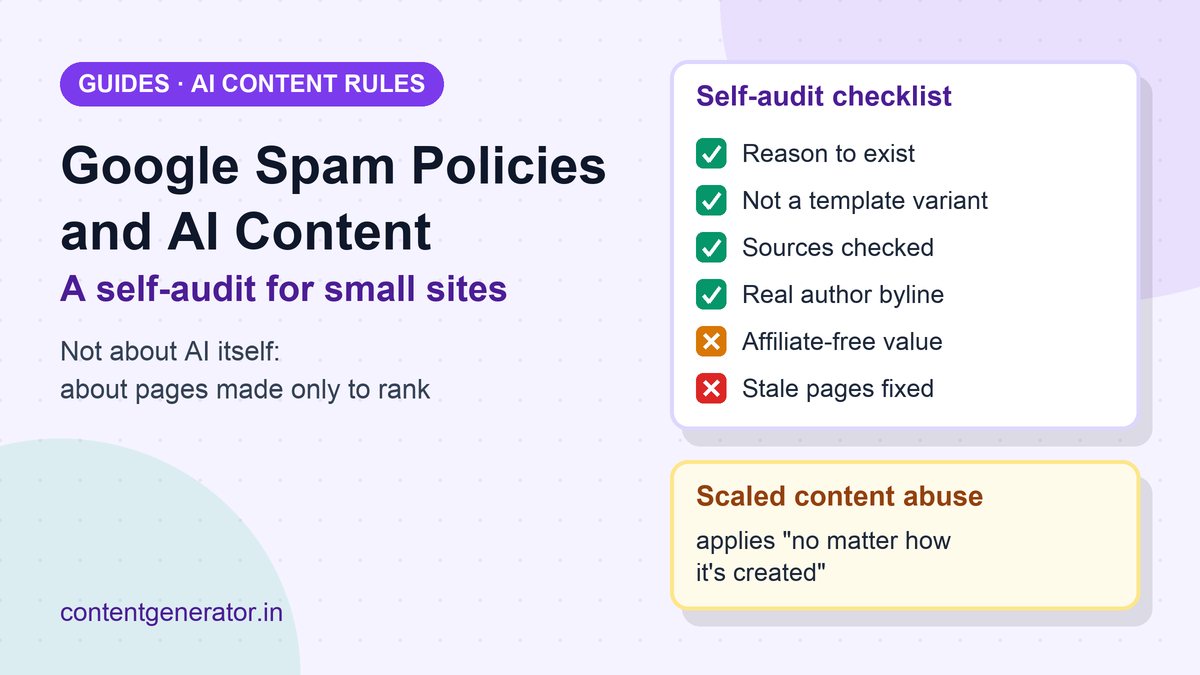
No. Google does not penalize content because AI helped write it. What it targets is a behavior: publishing pages in bulk that exist to rank rather than to help anyone. Google's spam policies call this scaled content abuse and say it applies "no matter how it's created." So the useful question for a small publisher is not "did I use AI?" but "would this page exist if search engines did not?"
That question is getting more attention this week. Search Engine Journal ran a piece on October 28, 2026 headlined "Google Signals A Wider Crackdown On SEO Spam," and Search Engine Land published a piece on human-first SEO the same day. Whatever the details of those stories turn out to be, the rulebook they point back to is a public document you can audit your own site against today. This guide walks through the parts that matter for AI-assisted writers and turns them into a checklist.
The Short Answer
- AI use is allowed. Google's guidance on generative AI says it can be useful for researching a topic and adding structure to original content.
- Bulk pages without added value are not. Using AI "to generate many pages without adding value for users" is listed by name as an example of scaled content abuse.
- The policy is method-neutral. Scaled content abuse covers scraping, stitching together other pages and spinning text too, not only AI.
- You must still review the output. Google says to manually fact-check AI content, including title elements, meta descriptions, structured data and image alt text.
- Consequences are real. Google says sites that violate its policies "may rank lower in results or not appear in results at all."
What the Policies Actually Say
Three Google documents matter here, and all three were refreshed recently: the spam policies, the guidance on using generative AI content (last updated October 1, 2026), and the guide to helpful, reliable, people-first content.
The spam policies define scaled content abuse as "many pages generated for the primary purpose of manipulating search rankings and not helping users," typically large amounts of unoriginal content that provides little to no value. The examples include generating many pages with AI tools without adding value, scraping feeds or search results, stitching together content from different pages, and creating multiple sites to hide the scaled nature of the content. For pages like this, Google's advice is to exclude them from Search.
The generative AI guidance adds the other half: AI output is not a source of facts. Google notes that generative models "don't retrieve facts, but predict a likely sequence of words," so errors are possible and every claim needs human checking before it goes live. It also suggests giving readers context on how content was created.
Where AI-Assisted Sites Actually Get Into Trouble
The policies are broader than the headline example, and several of them catch workflows that small publishers fall into by accident.
- Template pages at volume. Hundreds of near-identical "best X in [city]" or "X vs Y" pages, each prompted from the same template with a keyword swapped in, is the textbook scaled-content pattern.
- Light rewrites of other sites. The scraping policy covers copying content and modifying it only slightly, for example by substituting synonyms or using automated techniques, and republishing it. An AI "rewrite this article in your own words" workflow can land exactly here.
- Thin affiliate pages. Google's thin affiliation policy targets product affiliate pages whose descriptions and reviews are copied from the merchant without original value. Good affiliate pages, Google says, add pricing information, original reviews, rigorous testing, ratings, or product comparisons.
- Hosted third-party content. The site reputation policy covers third-party content (freelancers and white-label services are named as examples) published on an established site mainly to borrow its ranking signals. Editorial columns and articles are not what it targets; the issue is publishing content because of the host's ranking strength.
- Invented authors. The helpful-content guide says fabricating creator profiles, such as "AI-generated headshots, made-up names, or false credentials," is a form of deception and a signal of a low-quality page.
The Self-Audit Checklist
Run this on your own site, one section at a time. A "no" on any item is a prompt to fix or remove pages, not proof of a penalty.
- The existence test. For each post, can you state in one sentence what a reader gets here that they cannot get from the first page of results? If the answer is "a tidier summary of the same thing," the page adds little.
- The template test. Put ten of your newest posts side by side. If the headings, intro and conclusion could be swapped between them with a find-and-replace, you are producing variants, not articles.
- The source test. Does each factual claim trace to a primary source you opened yourself? Our AI content fact-check workflow shows a practical way to do this in under half an hour per post.
- The metadata test. Read titles, meta descriptions, alt text and any schema as a reader would. Google's guidance specifically extends the fact-check to these fields.
- The experience test. Where a post claims to have tested, tried or measured something, did that actually happen? Never fabricate first-person testing or statistics; add real examples, screenshots or data you have, or say plainly what you did not test.
- The byline test. Is it clear who is responsible for each page? Use a real author or a clearly labelled editorial team, never a made-up expert. Google encourages accurate authorship information.
- The disclosure test. Ask the "how" question from Google's guide: would a reader be surprised to learn automation helped produce the page? If so, explain how AI was used. Disclosure for reviews and endorsements has legal rules too; see our summary of the FTC rules for AI-written reviews and affiliate content.
- The affiliate test. Take away every affiliate link. Is the page still worth reading? Does it add pricing context, original testing or a real comparison?
- The stale-page test. Old pages that no longer help anyone drag down the whole set. Use a content refresh checklist to decide whether to update, merge or remove each one.
If you want a wider technical review as well, the SEO Toolls guide to an SEO content audit for small sites covers indexing, internal links and cannibalization, which this checklist does not.
What to Do With Pages That Fail
Google's own advice for scaled content abuse is to exclude it from Search, and the practical options follow from that:
- Rewrite with real value when the topic deserves a page: add original examples, firsthand details, current data and a clear point of view.
- Merge overlapping posts into one stronger page and redirect the others to it.
- Remove or noindex pages that cannot be improved and that nobody needs.
Google also notes on its spam updates page that automated systems may take months to learn that a site now complies with the policies, so fixes are not an overnight switch. The same page explains that Google occasionally improves its spam-detection systems, including the AI-based SpamBrain, and tells sites that see a change after a spam update to review the spam policies. That is the right order of operations: check against the policy first, then decide.
A Safer AI Workflow
Used well, AI sits in the research and structuring steps, not the publishing step. A workflow that stays on the right side of the policies looks like this:
- Pick a topic because readers ask about it, not because a keyword tool shows volume.
- Gather primary sources yourself and decide the angle before prompting.
- Use AI for outlines, drafts of sections you already know, or editing.
- Add what the model cannot: real examples, your own data, a specific recommendation.
- Fact-check every claim and every metadata field against the source.
- Publish at a pace you can quality-check. The policy is about scale without value, so there is no prize for speed.
Our AI content editing workflow turns steps 3 to 5 into a repeatable routine, and our earlier piece on AI content and SEO gives the broader picture of how Google treats AI-written pages. If you are tempted to run drafts through a detector first, read how accurate AI detectors really are before trusting the score.
Frequently Asked Questions
Does Google penalize AI-generated content?
Not for being AI-generated. Google's spam policies target scaled content abuse, meaning many pages created mainly to manipulate rankings, and say this applies no matter how the content is created. AI content that is accurate, original and useful is judged like any other content.
Do I have to label AI-assisted articles?
Google's guidance suggests sharing how content was created when readers might expect it, but it does not set a universal labeling rule for web pages. Separate rules can apply: Google Merchant Center requires specific metadata for AI-generated product images, and US advertising law requires disclosure of material connections in endorsements.
How many AI posts is too many?
Google does not publish a number. The policy turns on purpose and value, not a threshold: many pages generated to rank, with nothing added for users, is the problem. Publishing fewer, checked, useful pages is the safer approach.
Will fixing my pages restore lost traffic?
Possibly, but not immediately. Google says that making changes may help a site improve if its automated systems learn over a period of months that the site complies with the spam policies.
The Bottom Line
Google's rulebook does not ban AI; it bans pages that serve search engines instead of readers. If every post on your site has a clear reason to exist, sources you checked, a real byline and something the model could not supply on its own, a crackdown on SEO spam is not aimed at you. If a handful of posts fail the tests above, fix or retire them before anyone else has to decide for you.
Sources (checked October 29, 2026): Google Search Central, Spam policies for Google web search; Google Search's guidance on using generative AI content on your website (last updated October 1, 2026); Creating helpful, reliable, people-first content; Google Search spam updates and your site. News context: Search Engine Journal, "Google Signals A Wider Crackdown On SEO Spam" and Search Engine Land, "Human-first SEO: The risks of optimizing for AI over users" (both October 28, 2026), cited for timing only; this guide relies on the Google documents above.
Frequently asked questions
Does Google penalize AI-generated content?
Not for being AI-generated. Google's spam policies target scaled content abuse, meaning many pages created mainly to manipulate rankings, and say this applies no matter how the content is created. Accurate, original, useful AI-assisted content is judged like any other content.
Do I have to label AI-assisted articles?
Google's guidance suggests sharing how content was created when readers might expect it, but it sets no universal labeling rule for web pages. Other rules can apply: Google Merchant Center requires specific metadata for AI-generated product images, and US advertising law requires disclosure of material connections in endorsements.
How many AI posts is too many?
Google publishes no number. The policy turns on purpose and value: many pages generated to rank with nothing added for users is the problem. Publishing fewer, checked, useful pages is the safer approach.
Will fixing my pages restore lost traffic?
Possibly, but not immediately. Google says changes may help a site improve if its automated systems learn over a period of months that the site complies with the spam policies.