
FTC Rules for AI-Written Reviews and Affiliate Content: A Plain-English Guide
AI writing tools are legal; fake reviews and hidden paid links are not. What the FTC's 2024 reviews rule and Endorsement Guides mean for AI-assisted reviews and affiliate posts, with a disclosure checklist.
If you write reviews, comparison posts or affiliate content with help from AI, two sets of FTC rules matter to you: the Consumer Reviews and Testimonials Rule, which took effect on October 21, 2024, and the Endorsement Guides, last revised in 2023. Neither one bans AI writing tools. Both ban the same thing they always did: telling readers something false about who reviewed a product, what they experienced, or who paid them.
This guide explains what each set of rules covers, where AI changes the picture, and the disclosure habits that keep a content site on the right side of them. It is based on the FTC's own rule text, staff Q&As and press releases. It is a plain-English summary, not legal advice; if your business depends on reviews or endorsements, have a lawyer check your setup.
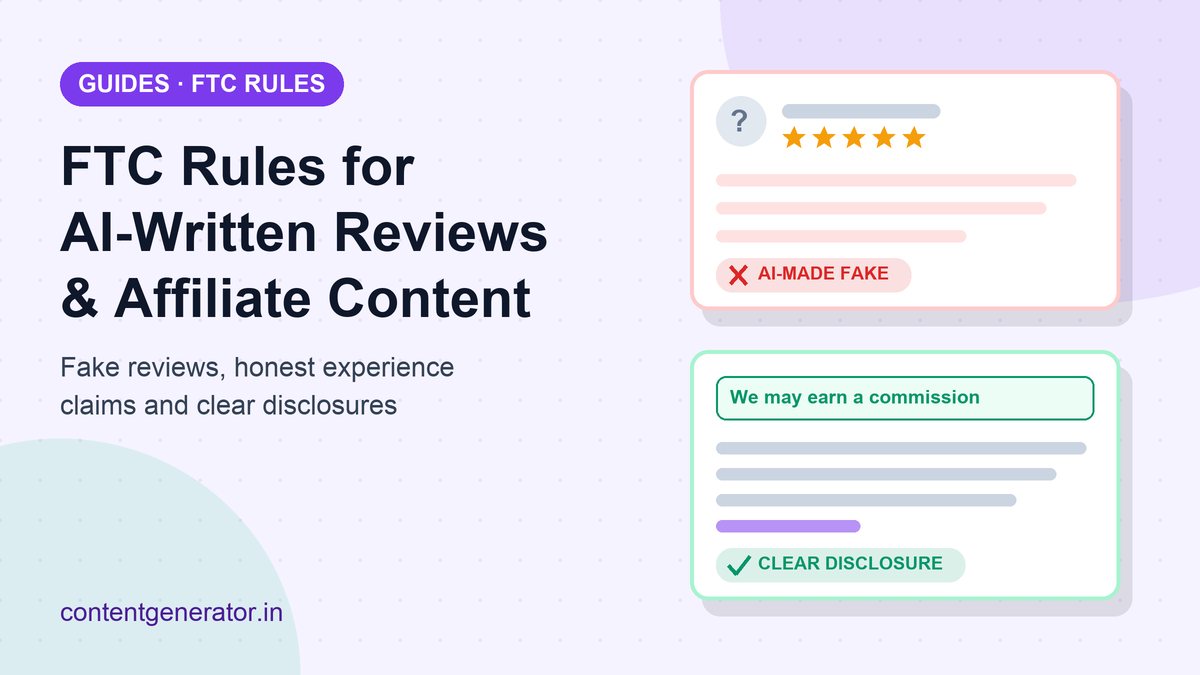
The Short Answer
- Using AI to help write is not illegal. The FTC's rules target deception, not the tool. No FTC rule requires a label on every AI-assisted article.
- AI-generated fake reviews are illegal. The FTC's announcement of the 2024 rule names "AI-generated fake reviews" as an example of a review by someone who does not exist. Writing, selling, buying or knowingly publishing them can lead to civil penalties.
- Experience claims must be true. A review that says "I used this for three months" has to come from a real person who did. An AI model cannot have that experience for you.
- Affiliate and sponsored links need a clear disclosure placed where readers see it before or alongside the recommendation, not hidden in a footer.
Rule 1: The Consumer Reviews and Testimonials Rule (16 CFR Part 465)
The FTC announced this rule in August 2024 by a 5-0 vote, and it went into effect on October 21, 2024. Its big change is enforcement: courts can now impose civil penalties for knowing violations, which the FTC said it needed after the Supreme Court's AMG Capital Management decision limited its ability to get money back for consumers under the FTC Act alone.
The parts most relevant to writers and content teams:
- Fake or false reviews and testimonials. The rule covers reviews that claim to be by someone who does not exist, by someone who never actually used the product, or that misstate the reviewer's experience. Businesses may not create or sell them, and may not buy them or publish testimonials they knew or should have known were fake.
- Insider reviews. Reviews by officers, managers, employees or agents need a clear and conspicuous disclosure of that connection.
- Paying for a particular sentiment. Offering money or perks on the condition that a review expresses a particular sentiment, positive or negative, is prohibited.
- "Independent" review sites a business secretly controls. A company may not present a website it controls as an independent source of reviews about a category that includes its own products.
- Review suppression through legal threats or intimidation, and fake social media indicators such as bought followers or views used to misrepresent influence.
Who is covered matters. According to the FTC's staff Q&A, ordinary consumers cannot be liable under the rule for what they write in reviews. Businesses can, and so can influencers who are in the business of posting testimonials. Advertising agencies, PR firms, review brokers and reputation management companies are explicitly "not immune": they can be liable if they write, create or sell fake reviews.
Where AI Fits In
The FTC's press release on the final rule says it was designed in part to "deter AI-generated fake reviews". In practice, that means the problem is not how a review was typed but whether it is honest about who is speaking and what they experienced. Some examples:
- Not a problem: a real customer writes rough notes and uses an AI tool to fix grammar, without changing what they said.
- A problem: generating twenty "customer reviews" from a prompt and posting them under invented names. That is a review by someone who does not exist.
- A problem: a "hands-on review" of software nobody on the team has used, drafted by AI from the vendor's feature page. The FTC's influencer guidance is blunt on this point: "You can't talk about your experience with a product you haven't tried."
- Depends: AI avatars in ads. The staff Q&A says the rule has "no blanket prohibition" on AI-generated avatars; an avatar presenting a testimonial is prohibited if the underlying testimonial is fake or false, and using a celebrity's likeness without permission to praise a product would violate the rule.
There is also a recent signal on the tool side. In 2024 the FTC settled with Rytr, an AI writing assistant, over a "Testimonial & Review" generator, and the order banned Rytr from offering AI review-writing services. On December 22, 2025, the FTC reopened and set that order aside by a 2-0 vote, finding the complaint did not support a violation and that the order unduly burdened AI innovation. The same release says the FTC "will continue to hold accountable actors that use AI to violate the law or deceive consumers." For writers, the takeaway is simple: the focus has moved from the tool to the person or business who publishes the fake review.
Rule 2: The Endorsement Guides and Affiliate Disclosures
The reviews rule does not tell influencers or bloggers how to disclose brand relationships; the FTC's Q&A says so directly. That job falls to Section 5 of the FTC Act and the Endorsement Guides (16 CFR Part 255), which were revised in 2023 with a new definition of "clearly and conspicuously". The Guides themselves are not law, but the FTC says practices that do not follow them can lead to Section 5 enforcement.
The core idea: if you have a connection to a brand that a "significant minority" of readers would not expect, and it could affect how they weigh your recommendation, disclose it. A connection includes payment, commissions, free or discounted products, and employment or family ties. Affiliate commissions count. The FTC also rejects the argument that "everyone knows bloggers get paid", noting that many creators recommend products with no connection at all.
How to disclose on a blog
The FTC's Disclosures 101 guide was written for social media, but its placement and wording rules translate directly to articles:
- Put it with the recommendation. A disclosure only in an About page, at the end of the post, or behind a "more" click is likely to be missed. On an affiliate post, a short line near the top, before the first affiliate link, is the safe pattern.
- Use plain words. "We may earn a commission if you buy through links on this page" or "Sponsored by Acme" works. The FTC lists "advertisement", "ad" and "sponsored" as clear terms and warns against vague ones like "sp", "spon" or "collab".
- Do not bury it in hashtags or links. A hashtag such as #ad is fine, but it is not required, and it should not disappear into a block of other tags.
- Match the language of the content. A Spanish-language review needs a Spanish disclosure.
- Put it inside videos, too. If you embed or publish a video review, the disclosure belongs in the video itself, not only in the description.
- Don't rely on a platform's built-in label alone. Use it in addition to your own disclosure.
A Compliance Checklist for AI-Assisted Review Content
- Every "I tested" or "we used" claim is backed by someone who actually used the product, and the details match what they found.
- Ratings and verdicts reflect the reviewer's honest opinion. The FTC's guidance says that if you are paid to talk about a product and thought it was terrible, you can't say it's terrific.
- No AI-written customer quotes, star ratings or "user stories" presented as real people.
- Affiliate, sponsored and free-product relationships are disclosed near the top and next to any boxed recommendation.
- Comparison pages that rank your own product say so plainly, rather than posing as an independent review site.
- Staff and family reviews disclose the connection. Incentives for reviews never depend on the review being positive.
- Facts the AI drafted (prices, features, dates) are checked against the vendor's own pages before publishing. Our guide on how to fact-check AI content covers a fast routine.
- If you hire an SEO or reputation agency, know how it gets reviews. The FTC's marketer guide warns that you can be held responsible for what such companies do on your behalf.
Do You Have to Say a Post Was Written With AI?
Under the FTC rules covered here, there is no general requirement to label an article as AI-assisted. The question the FTC asks is whether readers are misled about something that matters to them. A how-to guide drafted with AI and edited by a person is not deceptive by itself. A review that invents a human tester, or a byline implying expertise nobody involved has, can be. Platforms and search engines have their own policies, too: Google's position is covered in our post on AI content and SEO. Ownership is a separate question, explained in Can You Copyright AI-Assisted Writing?
The practical fix for most content teams is an editing pass that adds what only a person can: first-hand testing notes, real screenshots and a named reviewer who stands behind the verdict. Our AI content editing workflow and the guide to humanizing AI content show how to build that step into every draft.
Watch: The Fake-Review Rule in Brief
For a short video overview of the 2024 rule, this explainer covers the main prohibitions.
Sources (checked October 26, 2026): FTC, Final rule banning fake reviews and testimonials (August 14, 2024); FTC, The Consumer Reviews and Testimonials Rule: Questions and Answers; FTC, FTC's Endorsement Guides: What People Are Asking; FTC, Disclosures 101 for Social Media Influencers; FTC, Soliciting and Paying for Online Reviews: A Guide for Marketers; FTC, FTC Reopens and Sets Aside Rytr Final Order (December 22, 2025).
Frequently asked questions
Is it illegal to use AI to write product reviews?
No. The FTC's rules target deception, not the tool. It becomes illegal when AI is used to create reviews that claim to come from people who do not exist, from people who never used the product, or that misstate someone's real experience.
Do I have to disclose that a blog post was written with AI?
The FTC's reviews rule and Endorsement Guides contain no general requirement to label AI-assisted articles. You must not mislead readers about who tested a product or what they experienced, and you must disclose paid or affiliate relationships.
Where should an affiliate disclosure go on a blog post?
Near the recommendation, where readers will see it before they click: a short plain-language line near the top of the post, before the first affiliate link. FTC guidance says disclosures only on an About page or at the end of a post are likely to be missed.
What are the penalties under the FTC fake review rule?
The rule, in effect since October 21, 2024, lets courts impose civil penalties for knowing violations, which are assessed per violation. The FTC can also bring cases under Section 5 of the FTC Act.