
Can You Copyright AI-Assisted Writing? What the U.S. Copyright Office Says
You can protect what you wrote, rewrote and arranged, but not text an AI produced from your prompts. What the Copyright Office and the courts say, and what it means for blog posts and client work.
Short answer: in the United States you can copyright the parts of an AI-assisted piece that you wrote, rewrote, selected or arranged. You cannot copyright text that an AI tool produced on its own from your prompts, no matter how carefully you worded them. That is the position of the U.S. Copyright Office, and the courts have backed it up.
The question is getting fresh attention this month. New lawsuits over AI training and new "AI-assisted work" registries are in the news, and many writers now use ChatGPT, Claude or Gemini somewhere in their process. This guide explains what the official sources actually say, what that means for a blog post, a client article or a book, and what to do if you plan to register a work. It explains the rules in plain English. It is not legal advice.
The Rule: Copyright Needs a Human Author
U.S. copyright protects "original works of authorship." The Copyright Office has long read that to mean a human author, and its registration guidance from March 2023 says so directly: when a work contains AI-generated material, the Office asks whether the "traditional elements of authorship" were conceived and carried out by a person or by a machine.
The courts agree. In Thaler v. Perlmutter, Stephen Thaler tried to register an image and listed his AI system as the sole author. The U.S. Court of Appeals for the D.C. Circuit ruled against him in March 2025, holding that the Copyright Act requires human authorship. On March 2, 2026, the Supreme Court declined to hear his appeal (docket No. 25-449), so that ruling stands.
Note what the case did not decide. Thaler claimed no human role at all. Most writers are in a different position: they use AI somewhere in a process they direct. That is the situation the Copyright Office addressed in its January 2025 report.
What the Copyright Office's 2025 Report Says
In January 2025 the Office published Part 2 of its Copyright and Artificial Intelligence report, which covers copyrightability. Its main conclusions, in the Office's own framing:
- Prompts alone are not enough. Outputs are protected only where a human has determined sufficient expressive elements, and "the mere provision of prompts" does not do that. Even a long, detailed prompt does not make you the author of what the model writes, because the model, not you, decides how your instructions turn into sentences.
- Your own expression stays yours. If you feed in text you wrote and it is still perceptible in the output, that human-authored material remains protected.
- Arranging and modifying counts. A person who makes creative arrangements or modifications of AI output can be an author of those contributions.
- Using AI as a tool does not disqualify a work. The report confirms that AI assistance, or including some AI-generated material in a larger human-written work, does not bar copyright in the human parts.
- No new law needed. The Office found that the case had not been made for extra protection for AI-generated output.
The Office decides each case on its facts. There is no percentage rule such as "edit 30 percent and you own it."
What That Means for an AI-Assisted Article
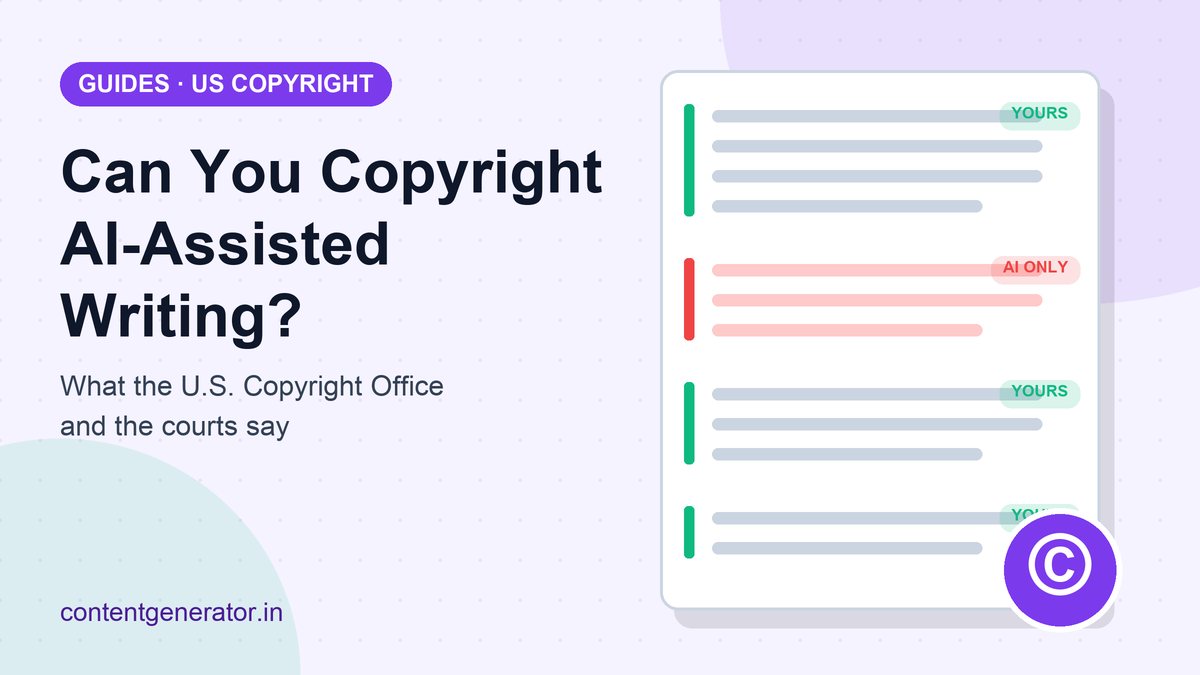
Picture a typical workflow: you write a brief, ask an AI tool for an outline and a rough draft, then rewrite most of it, add your own examples and reorder the sections. Under the Office's approach, the result has layers:
- Protected: paragraphs you wrote yourself, passages you substantially rewrote in your own words, your original examples and analysis, and the way you selected and arranged the material as a whole.
- Not protected: sentences the AI wrote that you left as they were, and any part whose wording the tool determined.
- Grey area: light edits such as swapping a few words or fixing grammar in an AI paragraph. Small changes may not add enough human expression to protect that passage.
The Office's 2023 decision on the comic book Zarya of the Dawn shows how this works in practice. The registration covered the text the author wrote and her selection, coordination and arrangement of text and images. The individual images generated with Midjourney were excluded. The book kept its protection, but only for the human contribution.
A practical point follows from this. The more of the final wording that comes from you, the more of the piece you can protect. A workflow where AI handles research prompts, outlines and first-pass suggestions, and you write the final text, leaves you with a strong claim. Publishing raw AI drafts leaves you with very little. Our AI content editing workflow and guide to humanizing AI drafts cover how to rewrite a draft properly rather than just polishing it.
Registering a Work That Includes AI Material
You don't have to register to own copyright in your human-written text; protection exists once the work is fixed. In the U.S., though, registration matters if you ever need to sue for infringement. If you do register, the 2023 guidance sets out the rules:
- Disclose AI-generated content that is more than de minimis (more than a trivial amount).
- Describe your contribution briefly, for example "text written by the author; selection and arrangement," and exclude the AI-generated material from the claim. The online application has fields for limiting the claim.
- Don't list the AI tool as an author or co-author.
- Correct older registrations. If you registered a work before and left out AI material that should have been disclosed, the guidance says to file a supplementary registration. A registration with inaccurate information can lose its benefits.
Unclear cases go to the Copyright Office's registration help pages or a copyright attorney. That matters most for a book or another work with real commercial value.
Client Work, Contracts and Tool Terms
For freelancers, the copyright question quickly becomes a contract question.
- Assignment clauses. Many client agreements say you assign copyright in the deliverable to the client, or treat it as work made for hire. You can only transfer rights that exist. If large parts of a deliverable are unedited AI text, there may be less to transfer than the client assumes.
- Originality warranties. Contracts often ask you to promise that the work is original and doesn't infringe anyone's rights. Read that clause before you use AI, and fact-check and plagiarism-check AI-assisted drafts (see how to fact-check AI content).
- Disclosure. Some clients and publishers ban or limit AI use; others only want to know about it. Agree on the policy in writing. If AI saves you time, decide how that affects your pricing. Our freelance writer rates guide covers how to price edited versus original work.
- Tool terms are not copyright. An AI provider's terms of service may say you own the output. That settles things between you and the provider, but it can't create a copyright that the law doesn't recognize.
A Quick Note for UK Readers
The UK takes a different approach. Section 9(3) of the Copyright, Designs and Patents Act 1988 says that for a literary work that is "computer-generated," the author is "the person by whom the arrangements necessary for the creation of the work are undertaken." How that applies to modern generative AI is debated, so don't assume the U.S. answer holds in the UK, or the UK answer in the U.S.
Keep a Simple Paper Trail
If authorship is ever disputed, records help. The habits cost little:
- Save your brief, outline and the AI output you started from.
- Keep version history (Google Docs and most editors do this automatically) so your rewrites are visible.
- Note which sections you wrote from scratch and which began as AI drafts.
- Keep your own research notes, interviews and examples. That material is clearly yours.
This also helps with search. Google's guidance focuses on whether content is helpful and original, not on whether AI was used. The same human editing that strengthens your copyright claim tends to improve the post. More on that in AI content and SEO.
Frequently Asked Questions
Can I copyright a blog post written entirely by ChatGPT?
Not the AI-written text itself. Under the Copyright Office's guidance, text whose expressive content was determined by the AI is not protected, even if your prompt was detailed. Your own additions, rewrites and arrangement can be protected.
Does a very detailed prompt make me the author?
No. The Office's 2025 report says prompts alone don't give enough human control over the expression in the output. A prompt you write can be protected as text in its own right if it is original, but that doesn't extend to what the model writes.
Can someone copy my AI-assisted article?
They can't copy the parts you authored, or your overall selection and arrangement, without risking infringement. Unedited AI passages are weaker ground. That is one more reason to rewrite drafts in your own words before you publish.
Sources (checked October 25, 2026): U.S. Copyright Office, Copyright and Artificial Intelligence, Part 2: Copyrightability (January 29, 2025) and NewsNet announcement; Registration guidance for works containing AI-generated material (88 Fed. Reg. 16190, March 16, 2023); Zarya of the Dawn decision letter (February 21, 2023); D.C. Circuit, Thaler v. Perlmutter opinion (March 18, 2025); Supreme Court docket No. 25-449 (certiorari denied March 2, 2026); UK Copyright, Designs and Patents Act 1988, section 9.