
AI Email Marketing for Ecommerce: What Four Platforms Actually Offer (2026)
Klaviyo, Mailchimp, Omnisend and Shopify all advertise AI for email. Here is what each vendor's own pages say it does, which plan it needs, and how to choose for your store.
"AI email marketing" covers four different things: drafting copy, building segments, deciding when to send, and answering questions about your results. Most ecommerce email platforms now advertise all four, but they do not give you the same amount of each, and some of it sits behind a paid plan. This guide compares what Klaviyo, Mailchimp, Omnisend and Shopify's own email tool say they offer, using each vendor's public pages checked on November 1, 2026, so you can match the platform to the size and habits of your store.
One limit up front: we did not run campaigns on these platforms for this article, so there are no open-rate claims here. Vendors change plans often, so confirm the current details on their pricing pages before you commit, especially with Black Friday on November 27, 2026.
The Short Answer
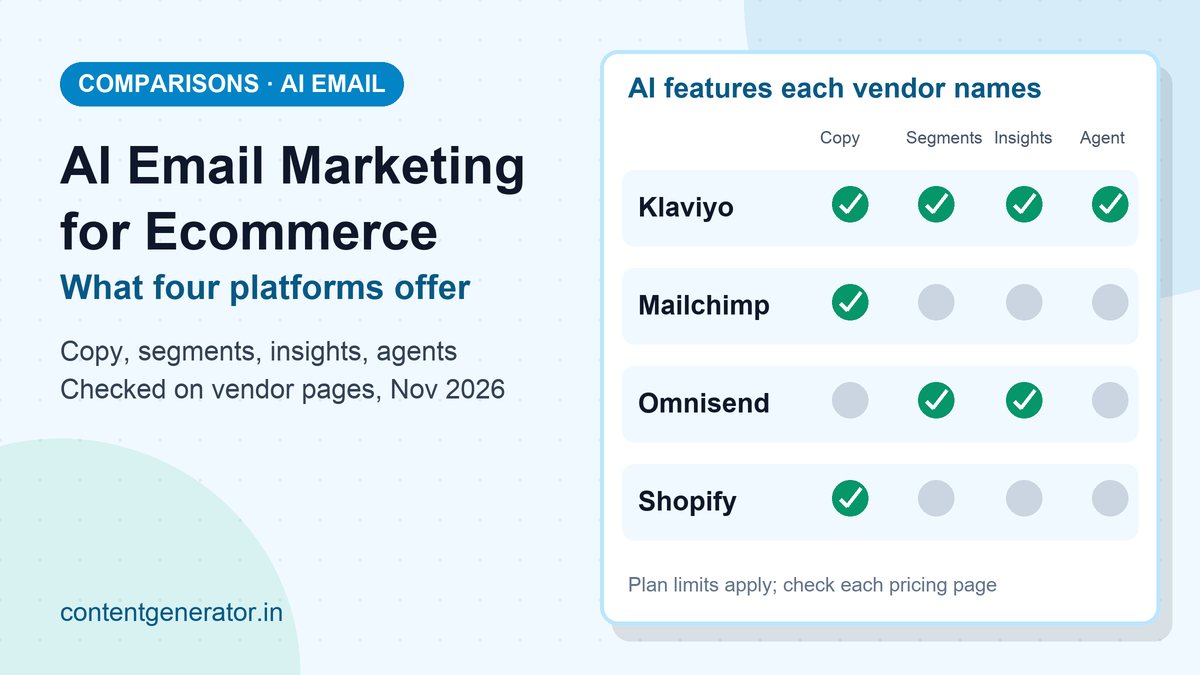
- Klaviyo has the broadest AI toolset on the pages we checked: generative tools for emails, SMS, segments and reviews, plus an AI "marketing agent" called Composer. The free plan is capped at 250 active profiles and 500 email sends a month.
- Mailchimp lists generative AI features as a no-additional-cost add-on on its Standard and Premium plans, and as not included on Essentials or Free.
- Omnisend puts its AI into forms, audience segments and plain-language answers about your data. Its free plan allows 500 emails a month to 250 contacts.
- Shopify's email tool is the lightest option: templates, an AI assistant (Sidekick) for editing emails, and pricing that scales with the number of emails you send.
- For a very small store, the AI copy writer is the least valuable part. The parts that save real time are segmentation and automated flows.
The Four Jobs AI Does in Ecommerce Email
Before comparing brands, separate the jobs, because platforms are strong in different ones:
- Copy. Subject lines, preview text and body drafts. Any general chatbot can do this, so it is the weakest reason to pick a platform.
- Segments. Describing an audience in words ("customers who bought twice in 90 days") and having the tool build the rule. This needs your store data, so a platform has a real advantage over a stand-alone chatbot.
- Send time and prediction. Choosing when each person gets a message, or estimating what they might buy next.
- Analysis and agents. Asking questions of your campaign and revenue data, or letting an assistant draft and schedule work for your approval.
Klaviyo: The Deepest AI Toolset
Klaviyo's AI page describes generative tools it calls Segments AI, Email AI, SMS AI and Reviews AI, plus agents: Composer, a marketing agent, and a Customer Agent for service. Its "what's new" section says Composer is now out of preview and can answer harder questions across your data, run analyses and audits on a schedule, and turn workflows that work into reusable skills. Its AI page also lists personalized send time among its capabilities.
On pricing, Klaviyo's page shows a free plan with up to 250 active profiles, 500 email sends a month, $5 of mobile messages a month, $5 of Composer usage a month and an AI-powered subject line generator. Paid pricing is on Klaviyo's pricing page, so check it for your list size.
Best for: stores that already have meaningful purchase data and want segmentation and analysis, not just copy.
Mailchimp: AI Depends on the Plan
Mailchimp's pricing comparison table lists "Generative AI features" as a no-additional-cost add-on on the Premium and Standard plans, and as not included on Essentials and Free. A separate note says Intuit Assist functionality (beta) is available to certain users on Premium, Standard and legacy plans in select countries, in English only, at no additional cost "at this time", and that terms can change without notice.
The practical reading: if AI drafting matters to you, budget for Standard or above, and re-check what is included when you renew. Mailchimp also positions its free plan for businesses with fewer than 500 contacts.
Best for: stores already on Mailchimp that want help with drafts and are happy on a mid-tier plan.
Omnisend: AI Aimed at Forms and Segments
Omnisend's AI page describes three tools: a Forms AI assistant that builds a sign-up form from your description (fully editable afterwards), an audience tool that analyzes your audience and builds segments, and AI insights that give instant answers from your Omnisend data. Its pricing page says the Free plan includes up to 500 emails a month and 250 contacts, and that you can use its features on that plan, up to those limits.
Best for: small and mid-size stores that want ready-made segments and quick answers without a steep learning curve.
Shopify: Simple and Built In
Shopify's messaging page describes email and SMS campaigns with ready-made templates, quick email edits with Sidekick, and insights in one place, with "pricing that scales with your sends". It says rates drop automatically after your first 300,000 emails in a month, and that SMS is charged separately. That page names Sidekick for email editing; it does not describe AI segments or agents the way Klaviyo's and Omnisend's pages do, so treat it as a convenient starting point.
Best for: new stores that want email running inside the Shopify admin on day one.
Side by Side
| Platform | AI features named by the vendor | Free tier (vendor page) |
|---|---|---|
| Klaviyo | Email, SMS, segments and reviews AI; Composer marketing agent; send time | 250 profiles, 500 emails a month |
| Mailchimp | Generative AI on Standard and Premium; Intuit Assist beta | Free plan for under 500 contacts, no generative AI |
| Omnisend | Forms AI, audience segments, AI insights | 250 contacts, 500 emails a month |
| Shopify | Sidekick for editing emails | Priced by sends; see Shopify's calculator |
How to Choose in Five Minutes
- Count your active customers. Under a few hundred, any free tier works and the AI differences barely matter yet.
- Ask where your time goes. If it is writing, a general chatbot plus a good brief is enough (see our AI content brief checklist and prompt writing formula). If it is building audiences and flows, favor the platform with segment tools.
- Check the plan gate. Confirm the AI features you want are on the plan you will actually pay for, as with Mailchimp's table.
- Price your list at its Black Friday size. Profile-based pricing can jump when you import a list or run a sign-up promotion.
- Keep a human review step. Whatever the tool writes, a person should read it before it sends.
The Part AI Does Not Fix
AI drafts do not make an email lawful or accurate. A subject line, a "was" price or a missing postal address is still your responsibility, which is why we wrote a separate CAN-SPAM and Gmail pre-send checklist for Black Friday emails. If you publish AI-assisted content around your campaigns, our guides on Google's spam policies and AI content and whether AI detectors are accurate cover the content-quality side.
FAQ
Which platform has the best AI for ecommerce email?
On the vendor pages we checked, Klaviyo lists the widest set of AI tools, including an AI marketing agent. "Best" depends on your store: a tool you can afford at your list size and will actually use beats a longer feature list.
Is there a free AI email marketing tool for ecommerce?
Klaviyo and Omnisend both publish free plans with small limits (500 emails a month). Klaviyo's free plan includes an AI subject line generator. Mailchimp's comparison table lists generative AI as not included on its Free plan.
Do I need a dedicated platform, or is a chatbot enough?
A chatbot can draft copy. A platform adds value when the AI can use your store's customer and order data to build segments and automate flows.
Can AI send emails without my approval?
Treat that as a setting to check, not an assumption. Review every automated flow and campaign before it goes live, and keep the legal basics (accurate subject line, opt-out, postal address) in your template.
Sources (checked November 1, 2026): Klaviyo, Pricing and AI overview; Mailchimp, Marketing pricing; Omnisend, Pricing and AI features; Shopify, Shopify Messaging. Plans, limits and features change often; confirm current details with each vendor. We have no affiliate relationship with these vendors for this article.
Frequently asked questions
Which platform has the best AI for ecommerce email?
On the vendor pages we checked, Klaviyo lists the widest set of AI tools, including an AI marketing agent. The best choice depends on your store: a tool you can afford at your list size and will actually use beats a longer feature list.
Is there a free AI email marketing tool for ecommerce?
Klaviyo and Omnisend both publish free plans with small limits (500 emails a month). Klaviyo's free plan includes an AI subject line generator. Mailchimp's comparison table lists generative AI as not included on its Free plan.
Do I need a dedicated platform, or is a chatbot enough?
A chatbot can draft copy. A platform adds value when the AI can use your store's customer and order data to build segments and automate flows.
Can AI send emails without my approval?
Treat that as a setting to check, not an assumption. Review every automated flow and campaign before it goes live, and keep the legal basics (accurate subject line, opt-out, postal address) in your template.