
Freelance Writer Taxes in the US: 1099s, Estimates and Deductions
Self-employment tax, the new $2,000 Form 1099-NEC threshold, quarterly estimated payment dates for 2026 and the deductions freelance writers commonly claim, explained from IRS sources.
If you earn money from freelance writing in the United States, the IRS treats you as a small business. That means three jobs on top of the writing: report every dollar of income (whether or not a client sends you a 1099), pay self-employment tax on your profit, and send the IRS estimated payments during the year instead of settling up only in April. The good news is that ordinary writing costs, from your AI writing subscription to a dedicated home office, reduce the profit you are taxed on.
This guide covers the 2026 tax year, the one you will file for in spring 2027, using the IRS's own pages and publications. Two reporting rules changed for 2026, and the last estimated payment for the year is due on January 15, 2027, so now is a good time to check your numbers. It is a plain-English summary, not tax advice; if your situation is complicated (an S corporation, income in several states, one very large contract), a CPA or enrolled agent is worth the fee.
The Short Answer
- All freelance income is taxable, including payments that never show up on a 1099. The forms are how clients report payments to the IRS; they do not decide what you owe.
- Self-employment tax is 15.3% (12.4% Social Security plus 2.9% Medicare) on your net earnings from self-employment, on top of regular income tax, once those earnings reach $400 or more.
- Pay quarterly if you expect to owe $1,000 or more when you file. For 2026 income, the remaining deadline is January 15, 2027.
- Deduct ordinary business costs on Schedule C: software and AI tool subscriptions, a home office, business mileage and similar expenses. You can also deduct half of your self-employment tax, and many writers qualify for the qualified business income (QBI) deduction.
What Changed for the 2026 Tax Year
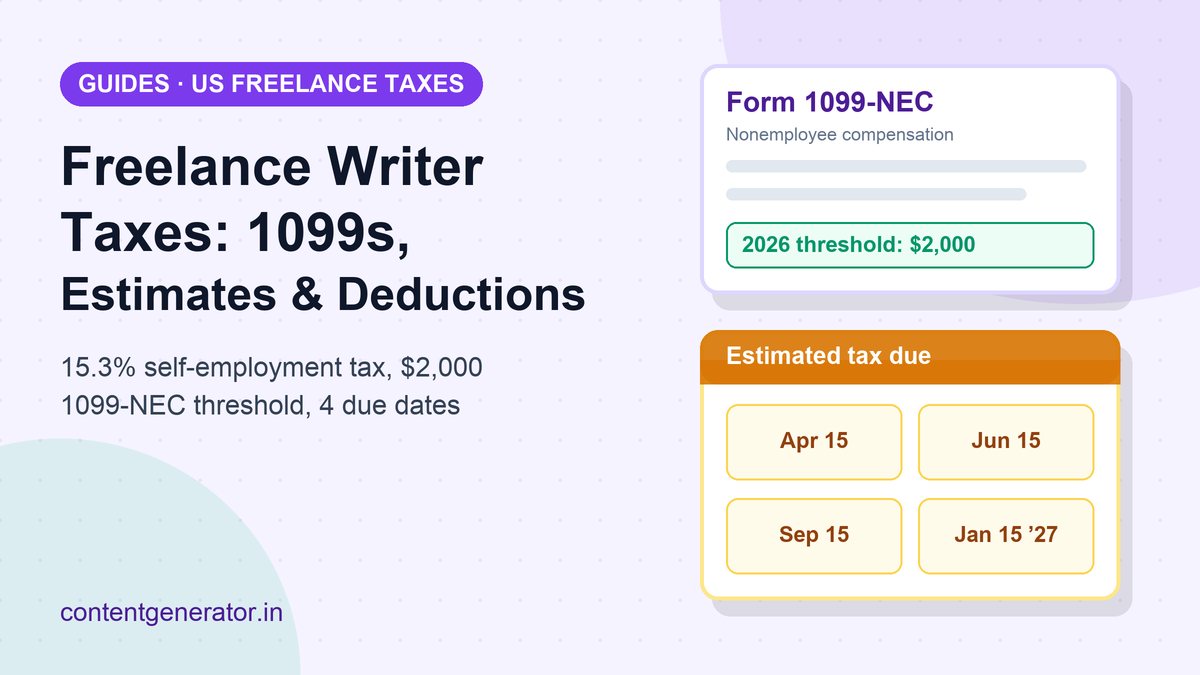
The 1099-NEC threshold rose from $600 to $2,000
For years, a client had to send you a Form 1099-NEC once they paid you $600 or more in a year. The IRS instructions for Forms 1099-MISC and 1099-NEC now say that for tax years beginning after 2025, the minimum reporting threshold increased to $2,000, and that it may be adjusted for inflation beginning in 2027. The change comes from the 2025 law the IRS refers to as the One, Big, Beautiful Bill.
In practice: a client who paid you $1,500 for three blog posts in 2026 no longer has to send you a 1099 for it. The $1,500 is still income you must report. Writers with many small clients will receive fewer forms in early 2027, so your own invoice records, not the stack of 1099s, have to be the source of truth.
The 1099-K stays at $20,000 and 200 transactions
If clients pay you through a payment app or an online marketplace, the platform only has to send a Form 1099-K when your payments for goods or services total over $20,000 in more than 200 transactions. The IRS notes that platforms may still send one for smaller amounts. The same rule applies either way: business income is reportable whether or not a form arrives, and money that is not business income (a friend paying you back for dinner, say) is not.
Self-Employment Tax, Explained Simply
Employees split Social Security and Medicare taxes with their employer. As a freelancer you pay both halves yourself through Schedule SE, which is why the rate is 15.3%:
- 12.4% for Social Security, which applies only up to the year's wage base. The Social Security Administration lists that base as $184,500 for 2026 and $192,300 for 2027.
- 2.9% for Medicare, with no cap. Higher earners can also owe an additional 0.9% Medicare tax above a threshold that depends on filing status.
Schedule SE trims your net profit slightly before applying the rate (to 92.35% of it), so the tax lands a little under 15.3% of profit. On $60,000 of net profit from writing, self-employment tax comes to roughly $8,500, before any income tax. The IRS then lets you deduct the employer-equivalent half of that amount when you calculate your adjusted gross income, which lowers your income tax (though not the self-employment tax itself).
The key word in that example is profit. Self-employment tax is charged on what is left after business expenses, which is why tracking deductions matters more for freelancers than for most employees.
Quarterly Estimated Taxes: The 2026 Due Dates
No employer withholds tax from your freelance payments, so the IRS expects you to pay as you go. Individuals and sole proprietors generally have to make estimated payments if they expect to owe $1,000 or more when they file. These are the IRS payment periods, with the dates that apply to 2026 income:
| Income earned | Payment due |
|---|---|
| January 1 to March 31, 2026 | April 15, 2026 |
| April 1 to May 31, 2026 | June 15, 2026 |
| June 1 to August 31, 2026 | September 15, 2026 |
| September 1 to December 31, 2026 | January 15, 2027 |
The periods are uneven: the second covers only two months and the last covers four. Underpaying in a period can trigger a penalty even if you end up with a refund when you file.
The safe-harbor rule keeps this manageable. Most taxpayers avoid the underpayment penalty if they owe less than $1,000 after withholding and credits, or if they paid at least 90% of the current year's tax or 100% of the tax shown on the prior year's return, whichever is smaller. Higher-income filers face a stricter prior-year test, explained under "Higher income taxpayers" in IRS Publication 505. You can pay through your IRS online account, IRS Direct Pay from a bank account, by phone or with the IRS mobile app; Form 1040-ES includes a worksheet for working out the amount.
If you also have a salaried job, there is a simpler route: raise the withholding on your paycheck with a new Form W-4 to cover your freelance tax, instead of (or as well as) sending quarterly payments.
Deductions Freelance Writers Commonly Claim
Business expenses go on Schedule C. The test is whether a cost is ordinary and necessary for your writing business; personal use has to be split out. The usual ones for writers:
- Software and subscriptions. AI writing assistants, grammar checkers, SEO tools, cloud storage and website hosting. If you are choosing between paid plans, our comparisons of ChatGPT vs Claude for writing and the best AI writing tools for 2026 list current monthly prices. Keep the receipts; a subscription you also use personally may need to be split.
- Home office. If part of your home is used regularly and exclusively for the business, the IRS simplified option allows $5 per square foot for up to 300 square feet, a maximum of $1,500, with no depreciation to track. The regular method uses actual expenses and takes more record-keeping.
- Business mileage. Driving to a client meeting, an interview or a conference counts; your normal commute does not. The IRS standard rate for business use was 72.5 cents per mile from January 1 to June 30, 2026, and is 76 cents per mile from July 1 to December 31, 2026, so date the entries in your mileage log.
- Equipment, education and professional costs. A laptop used for work, courses that improve your current writing skills, professional memberships and the fee for a tax preparer.
- Half of self-employment tax, as described above, taken as an adjustment to income rather than on Schedule C.
- The QBI deduction. Many sole proprietors can deduct up to 20% of their qualified business income, whether or not they itemize. For tax years beginning after 2025, IRS Publication 505 adds a minimum: if you have at least $1,000 of qualified business income from an active trade or business, you may be able to claim a minimum QBI deduction of $400. Income limits and phase-ins apply, so let tax software or a preparer run the calculation.
A Simple Tax System for a One-Person Writing Business
- Separate the money. Use one bank account and one card for business income and expenses. It turns Schedule C into a sorting job instead of an archaeology project.
- Log every invoice. Record client, date, amount and how you were paid. In January, compare the log with the 1099s that arrive; with the $2,000 threshold, expect gaps.
- Set money aside from every payment. Move a fixed share of each payment into a separate savings account for taxes. Many freelancers start around a quarter and adjust once they have a year of numbers; the right figure depends on your bracket and your state.
- Calendar the four deadlines next to your client deadlines. If you plan work with a content calendar, add the tax dates to it.
- Keep receipts as you go. A folder per year with software invoices, equipment receipts and the mileage log is enough for most writers.
- Price for taxes. Your rate has to cover self-employment tax, unpaid admin time and the benefits an employer would otherwise pay. Our guide to freelance content writer rates walks through setting an hourly floor.
Before January 15, 2027: A Year-End Checklist
- Total your 2026 invoices so far and project the rest of the year.
- Subtract expected business expenses to estimate net profit, then estimate self-employment tax and income tax on it.
- Compare what you have already paid with the safe-harbor amounts, and size the January 15 payment to close the gap.
- Check that every client has your current Form W-9 details, so any 1099 you receive is correct.
- Write down the business mileage and home-office square footage you will claim while you still remember them.
If writing is a side income, the same rules apply at a smaller scale: once your net earnings reach $400, Schedule SE is required, and income you get no form for still counts. If you are growing that side income into a full business, our guide to writing blog posts faster covers the other half of the equation: more billable output per hour.
Sources (checked October 27, 2026): IRS, Instructions for Forms 1099-MISC and 1099-NEC; IRS, Understanding your Form 1099-K; IRS, Self-employment tax (Social Security and Medicare taxes); Social Security Administration, Contribution and benefit base; IRS, Estimated taxes; IRS, When are quarterly estimated tax payments due?; IRS, Publication 505, Tax Withholding and Estimated Tax; IRS, Simplified option for home office deduction; IRS, Standard mileage rates; IRS, Qualified business income deduction.
Frequently asked questions
Do I have to report freelance writing income if I did not get a 1099?
Yes. Business income is taxable whether or not a client sends a Form 1099. For payments made in 2026, clients only have to issue a Form 1099-NEC once they pay you $2,000 or more, so many smaller payments will arrive without a form.
How much is self-employment tax for freelance writers?
The self-employment tax rate is 15.3%: 12.4% for Social Security (up to the year's wage base, $184,500 for 2026) and 2.9% for Medicare. It applies once your net earnings from self-employment reach $400, and you can deduct the employer-equivalent half when calculating adjusted gross income.
When are quarterly estimated taxes due for 2026 income?
April 15, 2026, June 15, 2026, September 15, 2026 and January 15, 2027. Estimated payments are generally required if you expect to owe $1,000 or more when you file.
Can I deduct AI writing tool subscriptions?
Software you use for your writing business, including AI writing assistants, is generally deductible on Schedule C as an ordinary and necessary business expense. If you also use the subscription personally, deduct only the business share.